High Voltage Cable: Above 36 kV, the Sheath Decides the Design
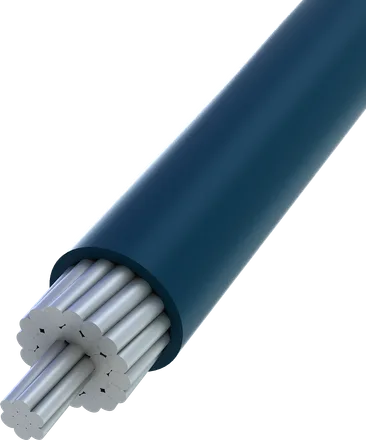
IEC 60840 covers extruded-insulation cable systems above 36 kV up to 150 kV (Uₘ = 170 kV); IEC 62067 covers 150 kV to 500 kV (Uₘ = 550 kV). The nameplate code U0/U(Um) — 127/220(242), for instance — states the design voltage to earth, which sets insulation thickness. It is the first number to fix against the network's earthing arrangement. Above 36 kV, cables are single-core, one per phase. Two consequences follow. Insulation becomes a cleanliness problem. Super-clean XLPE, triple extrusion with smooth semiconductor interfaces, and smooth-screen curing are standard practice, not options: at several kV/mm near the conductor surface, any void or trapped particle becomes a measurable partial-discharge site. Factory routine testing limits discharge to 5 pC per IEC 60840 — half the medium-voltage acceptance value. The sheath becomes an electrical component. Conductor current induces voltage in a continuous metallic sheath; bonded at both ends of a long route, it circulates substantial current. IEC 60287 counts this as sheath loss factor λ — added heat that directly reduces ampacity. Short feeders use single-point bonding with protectors limiting overvoltage at open ends; long feeders use cross-bonding, three transposed minor sections at bonding boxes so induced voltages sum toward zero. Acceptance is layered: type tests, prequalification under load cycling and impulse, on-site resonant AC withstand with partial-discharge monitoring, and sheath-circuit tests proving every bonding connection. Specify bonding scheme and pC limit alongside cross-section. A high voltage cable is bought as a system, never as a drum.
China XINYA Power Cables Co., Ltd Email: [email protected] Email: [email protected] whatsapp: +86 15289885778 Website: https://www.power-cables.com