Power cable materials: conductor, insulation, shielding and sheath
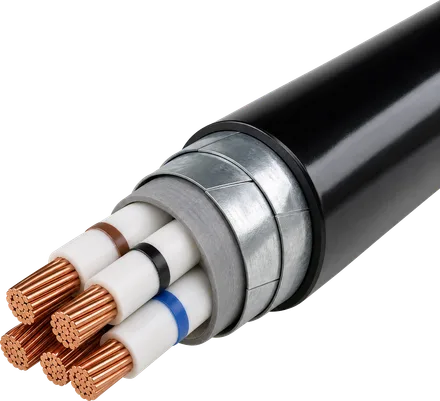
Every power cable is a stack of materials, each doing one job: the conductor carries current, the insulation holds the voltage, shields control the electric field and the sheath protects everything from the environment. The choice of each layer sets the cable’s current rating, maximum temperature, fire behaviour and service life. This guide explains the options used in the cables we manufacture. We produce finished cables only — we do not sell insulation or sheathing compounds as raw materials.
Copper conductor power cables
Copper has the highest conductivity of common conductor metals, so a copper cable carries more current than an aluminium cable of the same cross-section and stays compact in crowded trays and panels. Fixed-installation power cables such as YJV and VV use solid (class 1) or stranded (class 2) copper; flexible cords such as RVV use class 5 fine-stranded copper so they can bend repeatedly. Copper also gives reliable terminations with standard lugs.


Aluminium (aluminum) conductor power cables
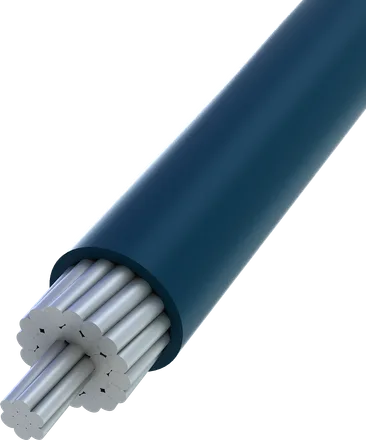
Aluminium weighs about a third as much as copper for the same volume and costs less, so aluminium cables such as YJLV and VLV are widely used for large cross-sections and long feeders where a slightly larger size is acceptable. Overhead lines rely on aluminium too: JKLYJ aerial insulated cable and JL-G1A steel-reinforced conductors. AA8030 aluminium alloy conductors, used in our AC90 cable, add creep resistance and flexibility so terminations stay tight over time.


Power cable insulation materials
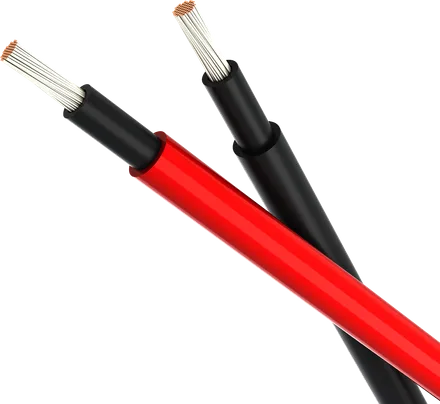
The insulation material sets the maximum conductor temperature, and that temperature largely sets the current rating. PVC is economical and easy to install but is limited to 70 °C. XLPE (cross-linked polyethylene) runs at 90 °C continuously and withstands 250 °C during a short circuit, which is why it is the standard for medium and high-voltage power cable. Electron-beam irradiated XLPE in low-smoke halogen-free form reaches 125 °C in building wire, cross-linked polyolefin handles the UV and heat of solar plants, and magnesium-oxide mineral insulation keeps circuits working in fire.
| Insulation | Max. conductor temperature | Typical cables |
|---|---|---|
| PVC | 70 °C | VV · VLV · RVV |
| XLPE | 90 °C (250 °C short circuit) | YJV · YJLV · JKLYJ |
| Irradiated XLPE, LSZH | 125 °C | WDZB-BYJ |
| Cross-linked polyolefin | −40 °C to +120 °C | PV1-F · H1Z2Z2-K |
| Magnesium oxide (mineral) | Circuit integrity at 950 °C for 3 h | BTTZ · BTTQ |

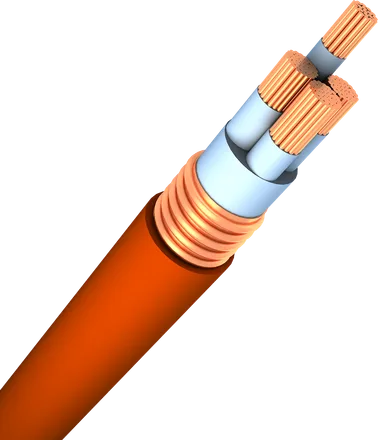
Conductor shielding materials (semi-conductive screens)
From 3.6/6 kV upward, a thin extruded layer of semi-conductive compound is placed directly over the conductor and another over the insulation. The conductor shield smooths out the strand surface so there are no sharp points concentrating the electric field, and the insulation shield gives a uniform outer boundary. Extruding conductor shield, insulation and insulation shield together in one pass keeps these interfaces clean, free of voids that would cause partial discharge. A copper tape or wire screen over the insulation shield then carries fault current to earth. Our medium-voltage cables are produced on a dry-cure triple-extrusion (CCV) line and tested for partial discharge in a fully shielded room.
Sheathing compounds for power cables
The outer sheath is chosen for the installation environment. PVC sheaths are flame-retardant and tough for general use. Polyethylene resists water and is preferred for wet underground routes. Low-smoke halogen-free (LSZH) compounds are used inside buildings, tunnels and metros where smoke and corrosive gas would endanger people and equipment. Solar cables use UV- and ozone-resistant cross-linked polyolefin, and mineral-insulated cables have a seamless copper sheath. Where the cable needs mechanical protection, steel tape or steel wire armour sits under the outer sheath.