Control Cable Selection Starts With the Signal Type
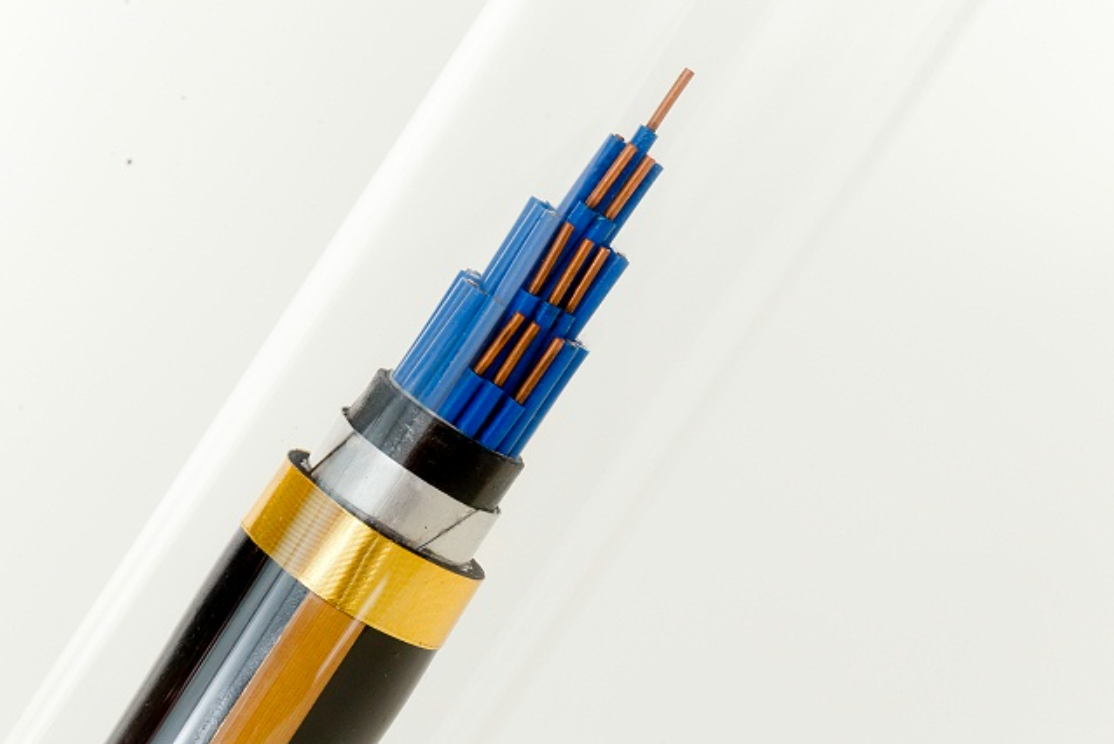
A control cable carries information, not power — the lines from pushbuttons, limit switches, relay contacts, sensor outputs and PLC or DCS cards. Two voltage families cover the field: 300/500 V construction under the EN 50525 and VDE 0814 series, typified by flexible PVC types such as LiYY and LiYCY, and 600/1000 V cables built to IEC 60502-1 for industrial control circuits. Process instrumentation follows EN 50288-7, typically 0.5 to 2.5 mm². Conductor class and identification decide buildability. Class 5 fine-stranded flexibility suits panel wiring and moving contacts; Class 1 or 2 solid or stranded conductors suit fixed runs. Core marking is a convention, not a style: colour coding per DIN 47100 works to roughly 25 cores, beyond which numbered black cores per IEC 60757 read faster. Interference handling is where specifications separate. Control runs share trays and cabinets with contactors, drives and power cables, so coupling paths matter. Twisting a signal conductor with its return exposes both to the same magnetic field and cancels induced noise — which is why analogue loops and communication lines use twisted pairs while plain switching signals can stay single-core. Electric-field coupling is addressed by screens: aluminium-polyester foil gives continuous coverage, tinned copper braid adds low transfer impedance; pairs can be screened individually, collectively, or both. A screen only works when earthed deliberately. Bonding both ends of a low-frequency analogue circuit lets ground-potential difference drive mains-frequency current through the screen and into the signal; 4–20 mA loops and thermocouple runs are therefore earthed at one point, conventionally the control-room end. High-frequency digital links need the opposite: short, multipoint terminations. An un-earthed screen behaves as an antenna. Environment closes the list: PVC to 70 °C or XLPE to 90 °C, halogen-free compounds for public buildings, armour against rodents and mechanical risk outdoors, and a CPR Euroclass declaration where the cable is a construction product. Choose the signal first and the core count follows.
China XINYA Power Cables Co., Ltd Email: [email protected] Email: [email protected] whatsapp: +86 15289885778 Website: https://www.power-cables.com