
Airport Power Cables Answer to Frequency Current Magnitude and Continuity
Airport lighting cable, airport control cable, aiport signal cable,airport power cables, 400 Hz ground power cable, airfield lighting cable, MH/T 6049 cable, constant current runway lighting
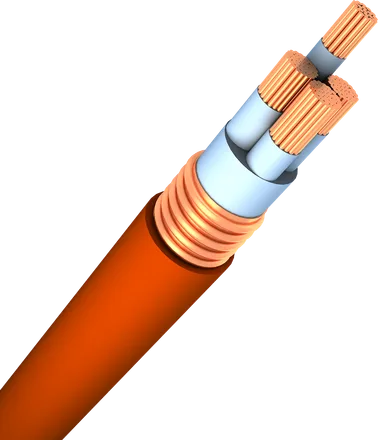
An airport has one of the strangest cable environments in infrastructure, because three zones impose physics that no ordinary building or utility specification combines. The terminal is general IEC 60502 territory — LV distribution, busbars, emergency power with EN 50575 Euroclass and circuit integrity for evacuation systems. Nothing unusual, except consequence: the same fire-class logic as any crowded public building, applied at scale. The apron is different in kind. Aircraft fixed ground power runs at 400 Hz, not 50 or 60 Hz, at 115/200 V, and frequency rewrites the cable's copper behaviour. Skin depth in copper at 400 Hz falls to roughly 3.3 mm, so current abandons the centre of a large conductor and crowds the surface: a single fat core heats disproportionately. Purpose-made GPU cable splits each phase into smaller parallel strands arranged to maximise surface area — the multi-conductor "6-around-1" and 3+3 geometries exist for this reason alone — typically around four power cores plus control conductors carrying the socket interlock signals, in halogen-free polyurethane sheath for oil, UV and deck-chemical resistance. Reusing 50 Hz cable on a 400 Hz feeder is a thermal derating error made visible only after years of silent overheating. The airfield is different again. Runway, taxiway and approach lights operate on a series circuit: a constant-current regulator pushes one of several fixed steps — the familiar 2.8 to 6.6 A ladder — through the whole loop, with isolation transformers at each light instead of parallel wiring. Cable fault does not black out the zone; brightness steps ride on current level. The cable itself is rated 5 kV regardless of that tiny current — MH/T 6049 in Chinese civil-aviation practice, per FAA specifications — with tinned copper conductors, XLPE or EPR insulation and 90 °C rating, routinely partial-discharge tested, because the loop sees lightning-impulse and switching surges from the regulator, not load current. Buy an airport cable by asking which of the three laws it must obey.
China XINYA Power Cables Co., Ltd Email: [email protected] Email: [email protected] whatsapp: +86 15289885778 Website: https://www.power-cables.com