Overhead Cable Design Is a Thermal and Mechanical Calculation Before It Is an Electrical One
overhead cable, ACSR conductor, AAAC overhead conductor, IEEE 738 conductor ampacity, sag tension calculation
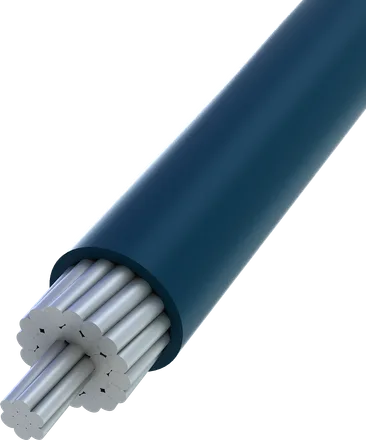
Overhead conductors are the only electrical equipment whose rating is set by weather. An overhead cable or bare stranded conductor carries current, but its limit is not insulation — it is the heat balance between gains and losses at the clamp point, and the mechanics of the span hanging between structures. The thermal logic is codified in IEEE 738. In steady state, Joule heating I²R plus absorbed solar radiation equals convective cooling to ambient air plus radiant emission from the strand surface. Wind increases convection, which is why a hot still evening, not a cold stormy night, sets the ampacity ceiling. Standard assumptions cap ordinary ACSR at 75 °C for spring/fall conditions, 90 °C as a summer or emergency rating, with elevated temperatures limited by annealing of the aluminium and by expansion that drops the conductor toward clearance obstacles below. Soft aluminium reaches about 70 °C and conventional alloys about 90 °C before the strength knee — the reason the rating is published as a table of current against temperature, wind and solar input rather than one number. The mechanical logic selects the line type. ACSR places galvanised steel core strands in the centre for tensile strength and aluminium layers outside for current. AAAC uses 6201 alloy throughout: lower breaking load per area than ACSR for the same diameter, but better corrosion life near coasts and no steel-aluminium contact corrosion. ACAR and composite-core types trade weight and thermal elongation for higher operating temperature or reduced sag. Every choice lands in the same equation family: sag equals weight per metre times span squared over eight times horizontal tension, with temperature change, ice and wind shifting the tension the tower heads actually see. Motion is the fatigue designer's subject. Aeolian vibration from wind at 0.5–10 m/s oscillates the span at 3–120 Hz with amplitudes near the strand diameter, concentrating bending at clamps — stockbridge dampers or spacer cables suppress it. Galloping needs a different answer: asymmetric ice shapes in stronger wind drive large low-frequency loops that dampers cannot arrest, so prevention lives in route selection and de-icing hardware. Specify an overhead cable by its rating conditions and its failure modes, not by its cross-section alone.
China XINYA Power Cables Co., Ltd Email: [email protected] Email: [email protected] whatsapp: +86 15289885778 Website: https://www.power-cables.com