Tiny, rich Singapore has big power needs and wants to go green. (ABC News: Daniel Mercer)
Australia and Singapore are neighbours, but not exactly close.
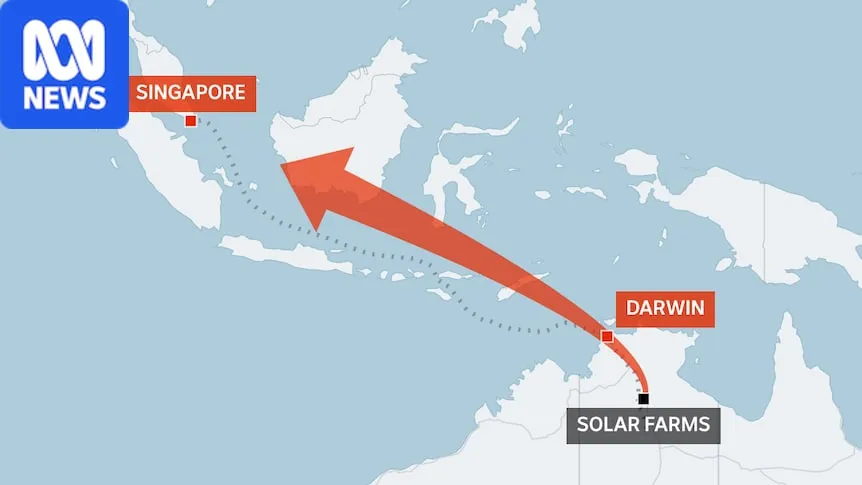
As the crow flies, the distance from Darwin, the capital of Australia's Northern Territory, to the South-East Asian island nation is 3,400 kilometres — by most standards, a very long way.
And yet it is this distance over which an Australian energy company is vying to lay the world's longest subsea electrical cable in the hope of tapping into a green dream.
That company is Sun Cable, a renewable energy developer backed by Australian tech billionaire Mike Cannon-Brookes.
Sun Cable aims to generate colossal amounts of solar power in the endless, sun-drenched expanses of Australia's Top End, supplying Singapore's 6 million consumers via a 4,300km transmission cable through the Indonesian archipelago.
"I'm not aware of too many other projects on this scale," James Bowen, an energy and geopolitical analyst, said.
Indeed, the exact scope of Sun Cable's $35 billion ambition is hard to comprehend.
It would involve building solar panels to produce up to 10 gigawatts across as much as 12,000 hectares — an area twice the size of Manhattan.
Battery storage on a similarly massive scale would back up the solar farm when the sun was not shining.
A computer-generated image of Sun Cable's proposed solar farm in the NT. (Supplied: Sun Cable)
Electricity would be transported 800km from the desert to Darwin, where some of it would support the local grid.
The vast majority, however, would be sent onwards to Singapore.
There, Sun Cable would supply up to 1.75 gigawatts of power, or about a quarter of the country's typical demand.
Amid persistent questions about the feasibility of Sun Cable's grandiose plans, the ABC travelled to Singapore to speak to potential customers.
Puah Kok Keong, chief executive of the Singapore Energy Market Authority, is the regulator of the nation's power and gas industries and one of its most senior energy officials.
Puah said his country's energy needs were intense.
Puah Kok Keong runs Singapore's Energy Market Authority, a regulator. (ABC News: Daniel Mercer)
He said air-conditioning in the famously steamy climate ran around the clock while industry chewed up as much as 80 per cent of power demand.
Added to the challenge of meeting that demand, he said Singapore wanted to become carbon-neutral.
Plus, Singapore is tiny — at fewer than 750 square kilometres, it is 13 times smaller than greater Melbourne.
"We have set for ourselves a goal of reaching net zero by the year 2050," Puah told the ABC.
Singapore, Puah said, was doing what it could within its own borders.
Solar panels are being installed everywhere — on roofs, on car parks and even on the city's reservoirs as floating installations.
With land at a premium, Singapore has resorted to floating solar farms. (ABC News: Daniel Mercer)
But he acknowledged it was a strategy with severe limits.
Even with the feverish activity, Puah said solar only supplies about 3 per cent of Singapore's power, a figure unlikely to increase by much more than double.
To reach net zero by the middle of the century, he said Singapore had started to look further afield.
"We are also looking at importing electricity from around the region," he said.
"We have set for ourselves a target of importing up to around 6 gigawatts of clean energy from the region by the year 2035."
It is into this equation that Sun Cable hopes to insert itself.
Currently, Singapore gets about 95 per cent of its electricity from natural gas, more than half shipped into the country as liquefied natural gas (LNG).
Singapore is heavily reliant on gas supplied by the likes of Shell. (ABC News: Daniel Mercer)
The rest is sourced via pipelines from neighbouring Malaysia and Indonesia.
Christophe Inglin from the Sustainable Energy Association of Singapore said the island state would have to do with renewable electricity what it had long done with fossil fuels.
"We've imported the oil and gas," Inglin said.
According to Inglin, Singapore already imports some electricity from Malaysia through a high-voltage transmission line, but these imports do not amount to much.
There are plans to dramatically increase the amount through a regional "super grid" that would much more closely weave together the electricity systems of South-East Asia.
From the highest levels, Singapore is seeking a more integrated Asian grid. (ABC News: Daniel Mercer)
Under such plans, Inglin said Singapore would be able to source hydro power from Laos, wind from Vietnam and huge amounts of solar from Malaysia and Indonesia.
"Without the regional grid, it wouldn't work," he said.
"Obviously, the political will and the technology have always been there. They go round and round.
"But I think we're seeing breakthroughs coming now. It's in the interests of both the exporting countries and the importing countries, Singapore."
Inglin said a South-East Asian network did not preclude Sun Cable, which declined to be interviewed for this story.
Australia borders the region, but he said the company faced long odds.
Tech billionaire Mike Cannon-Brookes sits behind Sun Cable. (AAP: Mick Tsikas)
"I think the Singapore government and the EMA [Energy Market Authority] keep a very open mind on that," he said.
"They say, 'If you can do it, bring it in … there's a market here for that.'
"Of course, they face enormous challenges. The sunshine is the least of them. They've got that.
"But how do you build that subsea cable for a viable enough price to bring it to Singapore? So, let's see."
Warnings about the viability of such an immensely long cable are not lost on observers.
Bowen, who is the industrial decarbonisation lead for Australia at the Institute of Energy Economics and Financial Analysis, said the theoretical neatness of the cable idea ran into harsh geopolitical realities.
Besides being six times longer than the world's longest subsea electrical cable — the Viking Link between Denmark and England — Bowen said the Australia to Singapore cable would face arguably greater risks.
For one, it would run through the waters of another country, Indonesia, which is also one of the globe's most seismically active.
A small island nation, Singapore depends on imports for everything. (ABC News: Daniel Mercer)
He said Singapore may also be unwilling to rely on a single cable responsible for the supply of so much of its electricity.
"Any time you have a single piece of infrastructure a country would be dependent on for its energy … there are risks to interdiction," Bowen said.
"We've always seen this around energy in general.
"Energy is just an inherently geopolitical concern, and countries are very careful … about how they calibrate their energy security strategies."
Puah from the Energy Market Authority echoed the comments.
"I think Sun Cable certainly faces quite a lot of challenges," Puah said.
"The distance, besides