The African Development Bank has approved a $2 million reimbursable grant for two renewable energy mini-grids in Ethiopia, testing a model that links electricity access directly with irrigation, farming and rural enterprise. The investment is small in financial terms, but it targets one of rural electrification's hardest problems: how to build clean-energy systems that remain commercially viable after the initial funding is spent.
The $2 million reimbursable grant, provided through the Sustainable Energy Fund for Africa, will cover up to 50 percent of the capital costs of the two projects. The mini-grids are being developed by RVE.SOL ETH Energy Generation Solutions PLC and form part of an $8 million financing package for the Distributed Renewable Energy and Agriculture Modalities programme, known as DREAM.
The Bank approved the wider financing package in May 2024, while its Board of Directors approved the latest grant on 17 July. The financing addresses a weakness that has complicated mini-grid development across many underserved rural markets. Supplying electricity is technically possible, but the commercial case can remain fragile when demand is limited mainly to household lighting, phone charging and small appliances.
These uses improve quality of life, but they may not generate enough predictable revenue to cover maintenance, operating expenses and eventual equipment replacement. Low and irregular consumption can leave developers dependent on subsidies, while tariffs high enough to recover costs may be unaffordable for rural households.
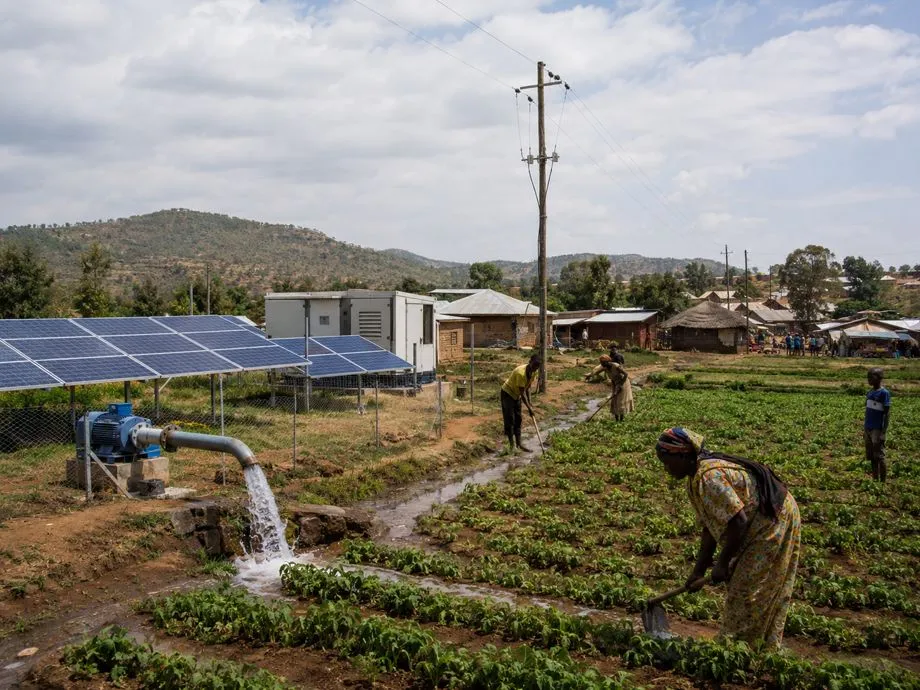
DREAM seeks to change that equation by building electricity demand around productive activities. Irrigation, farming operations and local businesses can consume power more consistently and, crucially, use it to generate income. The model treats electricity not only as a household service, but as an economic input.
At the centre of DREAM is an approach built around Anchor loads, Business demand and Community connections. Anchor users are intended to provide a stable foundation of electricity consumption. Businesses add commercially productive demand, while community connections extend electricity access to households and public users. By combining these customer groups, the projects aim to create a more dependable revenue base than mini-grids serving residential consumers alone.
Agriculture gives the model its strongest commercial logic. Electricity can support irrigation and other farm-related activities, helping create regular demand while potentially improving agricultural production. Stronger farming activity can then stimulate local businesses and household incomes, increasing the community's ability to pay for electricity.
This creates a potential cycle of mutual reinforcement. Farmers gain more reliable energy for productive use. Mini-grid operators gain customers whose electricity consumption is connected to income-generating activity. Local businesses benefit from both dependable power and increased agricultural output, while households receive connections supported by a broader commercial base.
The approach also brings the relationship between water, energy and food production into a single investment model. Irrigation requires both water and power. Agricultural productivity influences rural incomes. Those incomes affect demand for energy and other services.
Ethiopia's Minister of Water and Energy, Habtamu Itefa Geleta, has described DREAM as an integrated programme connecting renewable electricity with irrigation and agriculture. The initiative was developed by the Ethiopian government, the African Development Bank, the Global Energy Alliance for People and Planet and other partners.
Its significance lies in recognising that rural infrastructure cannot always be planned in isolation. A mini-grid may struggle if the surrounding economy remains weak, just as agricultural investment can underperform when farmers lack dependable power. DREAM attempts to develop both sides of that relationship together.
By covering up to half of the initial capital costs, the African Development Bank is reducing the amount the developer must finance in a market where investment risks may be difficult to price. Rural customers may have limited purchasing power, agricultural electricity demand can vary by season, and projects may take years to generate stable returns.
A reimbursable grant differs from straightforward non-repayable support because repayment may be required under specified conditions. The precise terms attached to the Lelicho and Murche financing will determine how much risk remains with the public funder and how much is ultimately carried by the developer.
The broader strategy is using concessional finance to make projects possible in areas that commercial capital may otherwise consider too risky.
African Development Bank Director for Renewable Energy and Energy Efficiency Daniel Schroth has presented the programme as an example of how partnerships and concessional funding can encourage private investment in underserved markets. The model is also intended to support employment, livelihoods and climate resilience alongside energy access.
However, attracting private capital will require more than demonstrating that a mini-grid can be constructed. Investors will examine whether customers pay consistently, whether agricultural demand meets projections and whether electricity revenues can sustain the infrastructure after concessional support declines.
Affordability will be a key tension. Tariffs must generate enough revenue to keep the mini-grids operational, but farmers, small businesses and households must also be able to pay them. Electricity that is reliable but unaffordable will not create the demand on which the model depends.
The projects will also require coordination across energy, water and agricultural systems. Delays in irrigation infrastructure or weak agricultural production could reduce projected power consumption. Conversely, unreliable electricity could undermine the productive activities expected to sustain the mini-grids.
The Global Energy Alliance for People and Planet believes DREAM could offer a blueprint for rural development across Africa. Its Vice President for Africa, Carol Koech, has argued that combining renewable energy with irrigation, market access and financial support can strengthen economic opportunity while improving the financial sustainability of infrastructure.
The immediate test will be whether the Lelicho and Murche projects are completed and operated reliably. The deeper test will be whether they generate enough productive demand to support maintenance, service quality and long-term financial stability.
Connection numbers alone will not be sufficient measures of success. The programme will need to show whether farmers use the electricity, whether irrigation and agricultural output improve, whether businesses expand and whether household connections remain affordable. It wil
Source: Devdiscourse